

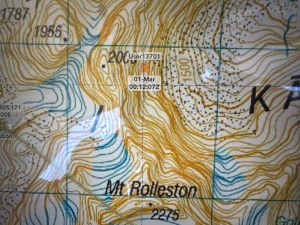
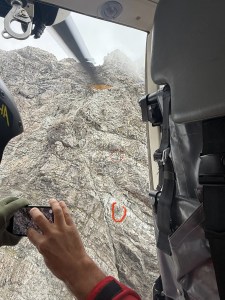
At 1:13 PM on Saturday, 1st March, our team was notified of a PLB activation on the north side of Mt Rolleston. Initial aerial reconnaissance by the Greymouth Rescue Helicopter located two young climbers approximately 300 meters up a cliff face adjacent to the Otira Face. The climbers were roped together, approximately 30 meters apart; the upper climber was at an anchor stance, while the lower climber appeared to be dangling below an overhang.
Our Response
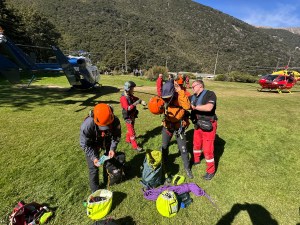
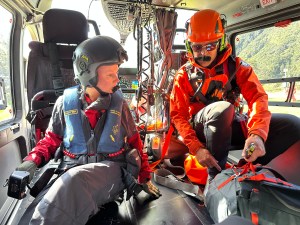
Two rescue teams were immediately deployed from the Garden City Helicopters (GCH) hangar in Christchurch, making their way to Arthur’s Pass. Both teams were winched onto a nearby ledge, from which they were able to climb across to the stranded climbers. After stabilising the situation, all six individuals, including the rescuers, were safely winched off the cliff face and transported to Arthur’s Pass Village without further incident.
What happened?
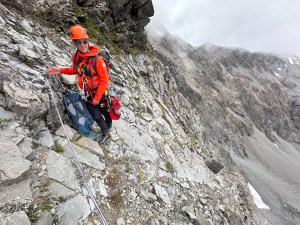
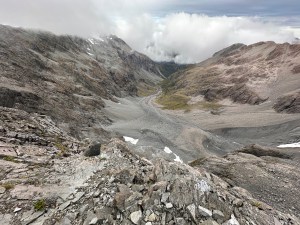
The two climbers were in good spirits and largely unscathed after the rescue. They had learned some valuable lessons after their ordeal. They had set off earlier that morning at 6am from the Otira valley carpark, with the goal of climbing the Otira Face of Mt Rolleston. During the approach, low valley fog obscured their view, disorienting them. Above the first rock band on the Otira Face, the climbers veered off route to the right, so instead of climbing the classic “Central Direct” buttress, they ended up climbing on the eastern face of point 2008, on the Philistine-Rolleston ridge. This was steep and loose terrain, they soon found themselves committed to the climb. While climbing, the seconder pulled loose off a loose block, taking a fall. The seconder was left dangling below an overhang, held by the leader’s anchor above. Without enough remaining rope to lower the seconder to a ledge, the climbing party were stuck and required assistance.
Learnings from this Rescue:
1. Even with an accurate PLB location, identifying subjects in complex alpine terrain can be challenging. Bright clothing, reflective materials, and visible movement (such as waving arms) greatly improve visibility for rescue teams.
2. Route-finding in low visibility, combined with steep and loose rock terrain, presents significant hazards for alpine climbers. Proper pre-planning, experience in alpine navigation, and an understanding of the risks of climbing in variable conditions are critical for safety.
3. Maintaining situational awareness and carrying appropriate emergency equipment, including extra anchor materials and a means of communication beyond a PLB (such as Garmin inReach), can improve self-rescue options while awaiting external assistance.



 Alpine Rescue Canterbury