
Leaving good intentions is essential for all back country users.
The advantage of intentions being with someone near and dear is they know you well, know how to contact you/where you live and are going to fight like hell to make sure the authorities know you are missing.
That being said, it is still all to easy for people to fail to leave good intentions.
Many SAR operations are activated for people undertaking short 1-2 day trips, which are often planned quickly to take advantage of a weather or time window, and intentions forms are often overlooked.
However, intentions can be crucial for a fast rescue.
What are Intentions?
Intentions provide supplementary information to assist with a SAR response.
A SAR response is activated if you are overdue and have made no contact, or you activate your beacon.
In either case, your intentions information is obtained from your emergency contacts.
WHO, WHAT & WHEN
The more information the better, but at minimum, your intentions should include the following basic information:
WHO… Is going: number & names of people in your party
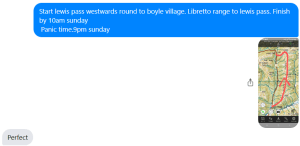
WHAT…. Are you doing & carrying: describe the route by either sending a screenshot of the map with your route drawn over it, and/or a list of tracks, valleys, passes, summits, and other landmarks you are passing through to define your route.
Let your intentions contact know what equipment you have – this can later help emergency services determine the urgency of the operation
WHEN… to call Police: what time should you be considered overdue.
How do you send intentions?
There are a few ways you can do this:
- Email, text or online message your emergency contacts with your Who, What & When.
- Adventure Smart have an online tool for building your intentions that then get emailed to you trusted person https://www.adventuresmart.nz/outdoor-intentions-form/
- Write your intentions down on a piece of paper and leave it at your home or flat in an obvious place – the kitchen table or noted against the fridge. Make 100% sure your emergency person has read this and is aware of your overdue time.
Overdue Time
We are huge proponents of the ‘overdue time’. This is the time after which you instruct your emergency contact to raise the alarm and contact the police. You don’t want our emergency contact oscillating about what to do. An overdue time reduces confusion.
How should you decide your overdue time?
This depends on a few factors:
- How much you have in the way of shelter, clothes & food
- The upcoming weather forecast.
Scenario 1: A day-walk, in fine weather followed by a southerly storm that night. A cold storm can be fatal for a lost party caught out with no shelter. Overdue time would be that evening. Note: the party would do well to start early to avoid being caught out, and to carry warm clothes and lightweight emergency shelters, just in case.
Scenario 2: Alpine day trip carrying emergency shelter, warm clothes, fine weather during the day and overnight. Overdue time would be midday the following day.
Scenario 3: A well-equipped 8-day transalpine trip. An extra few days overdue can cause an only slightly hungry party at the end such a trip, and is common when stuck on the wrong side of a swollen rivers. Parties often have satellite communication devices on longer trips. Overdue time would be a couple days after the planned finish point, however it is clear that this requires some judgement regarding the route, party, communication and weather.
In general, we would advocate for giving yourself the night and half the following morning to wriggle yourself out of trouble under you own steam. There have been a few SAR call outs prompted after the party was only 2 hours overdue. That barely equates to 1 stuck abseil rope and an extended lunch stop. This is a misuse of emergency services.
Give yourself some time to sort things out rather than sprinting to reception to let intentions know not to call the police.

Communication devices
Live tracking on devices such as Garmin inReach or Spot trackers are very helpful for tracking an overdue friend. Many back country users have not yet invested in these devices as they are fairly expensive.
In future, One NZ collaboration with Starlink plans to provide NZ with 100% back-country coverage, however this is not due until mid 2024 and is only for people on that network. Also, phones can run out of battery. It’s a technology in progress, so certainly a space to watch.
Rules of Thumb
- Overnight trip with no communication devices: give yourself extra overnight through midday the next day.
- You can make it tighter if you have comms but remember that electronic devices can run out of battery.
- Day trip: base it on what gear you have and the upcoming weather. Do you have comms? Are there huts/shelter around you? Do you have a good margin for making it through an overnight?
- For example, if expecting to be out before 2pm, bad/cold weather coming in, and minimal gear), this could mean an overdue time of 7pm.
- Longer trips with uncertainty around your date due out – take the most pessimistic and add 1-2 days. This would depend on how much food you are carrying have and if you might get stuck behind a swollen river etc.
Conclusion
Sending good intentions to your two or more emergency contacts is a process that every back country user should be in the habit of doing.
It can be as simple as a text message or a note, but it must include:
WHO is going, WHAT you are doing & carrying, and WHEN is your overdue time.
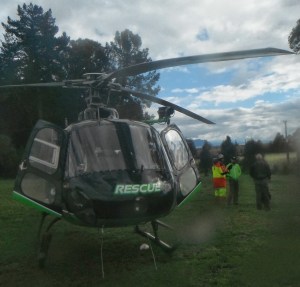
 Alpine Rescue Canterbury